

HPE7-A02 Exam Questions - Real & Updated Questions PDF
Pass Guaranteed Quiz 2026 Realistic Verified Free HP
HPE7-A02 certification is highly regarded in the field of network security, as it demonstrates a high level of knowledge and expertise in the area of Aruba network security solutions. Certified professionals are recognized as experts in their field and are highly valued by employers. Aruba Certified Network Security Professional Exam certification is also a valuable asset for those who are looking to advance their careers in the field of network security, as it demonstrates a commitment to professional development and ongoing learning.
NEW QUESTION # 95
What can help justify the extra cost of air monitors (AMs) to a company?
- A. AMs can support wireless clients when they are not actively containing a device, so companies benefit from better security and connectivity.
- B. AMs support tarpit containment, which introduces fewer legal issues than deauthentication containment.
- C. AMs can detect wireless threats much faster than hybrid APs, reducing the company's vulnerability surface.
- D. AMs support additional IDS/IPS features, such as malware and Trojan detection, to enhance overall security.
Answer: C
Explanation:
Dedicated air monitors are justified when a company wants faster and more complete wireless threat detection. Hybrid APs must divide radio time between serving clients and scanning the RF environment. Dedicated AMs focus on monitoring, which allows them to detect rogue APs, evil- twin behavior, unauthorized SSID use, ad hoc networks, and other wireless threats more quickly.
Faster detection reduces the time an attacker can operate unnoticed and lowers wireless exposure. AMs do not provide endpoint malware or Trojan detection in the same way an endpoint or gateway security engine does. They also do not serve wireless clients while operating as dedicated monitors. The clearest security justification is faster wireless threat detection compared with hybrid scanning.
NEW QUESTION # 96 
You have downloaded a packet capture that you generated on HPE Aruba Networking Central. When you open the capture in Wireshark, you see the output shown in the exhibit.
What should you do in Wireshark so that you can better interpret the packets?
- A. Choose to decode UDP port 5555 packets as ARUBA_ERM and set the Aruba ERM Type to 0.
- B. Apply the following display filter: wlan.fc.type == 1.
- C. Edit the Enabled Protocols and make sure that 802.11, GRE, and Aruba_ERM are enabled.
- D. Edit preferences for IEEE 802.11 and chose to ignore the Protection bit with IV.
Answer: A
Explanation:
To better interpret the packets shown in the Wireshark capture, you should choose to decode UDP port 5555 packets as ARUBA_ERM and set the Aruba ERM Type to 0. This configuration will allow Wireshark to properly decode and display the Aruba-specific encapsulated remote mirroring (ERM) packets, providing a clearer understanding of the traffic.
1.Decoding Protocols: Selecting the correct protocol decoding in Wireshark ensures that the captured packets are interpreted correctly, displaying the relevant information.
2.Aruba ERM: The packets in the capture are likely encapsulated remote mirroring (ERM) packets specific to Aruba, which require proper decoding settings in Wireshark.
3.Clear Interpretation: By setting the Aruba ERM Type to 0 and decoding the packets as ARUBA_ERM, you can view the encapsulated data accurately.
Reference: Wireshark documentation and Aruba network packet analysis guides provide instructions on setting protocol decoding options to accurately interpret specific types of network traffic, such as Aruba ERM packets.
NEW QUESTION # 97
Which statement describes Zero Trust Security?
- A. Companies should focus on protecting their resources rather than on protecting the boundaries of their internal network.
- B. Companies that support remote workers cannot achieve zero trust security and must determine if the benefits outweigh the cost.
- C. Companies can achieve zero trust security by strengthening their perimeter security to detect a wider range of threats.
- D. Companies must apply the same access controls to all users, regardless of identity.
Answer: A
Explanation:
Zero Trust Security is a security model that operates on the principle that no entity, whether inside or outside the network, should be trusted by default. Instead, every access request is thoroughly verified before granting access to resources. This model emphasizes protecting resources rather than merely securing the network perimeter, acknowledging that threats can originate both inside and outside the network.
1.Resource Protection: Zero Trust focuses on securing individual resources, assuming that threats can bypass traditional perimeter defenses.
2.Verification: Every access request is authenticated and authorized regardless of the source, ensuring that only legitimate users can access sensitive resources.
3.Modern Security Approach: This model aligns with the evolving threat landscape where insider threats and advanced persistent threats are common.
NEW QUESTION # 98
You are proposing HPE Aruba Networking ZTNA to an organization that currently uses a third- party, IPsec-based client-to-site VPN.
What is one advantage of ZTNA that you should emphasize?
- A. ZTNA improves security for SaaS applications, which now make up the majority of remote user traffic.
- B. ZTNA offers no greater security than the current solution, but it makes it much easier for admins to create and maintain consistent policies.
- C. ZTNA is specifically designed to enhance security for Internet of Things (IoT) devices, which traditional client-to-site VPNs cannot address.
- D. ZTNA shrinks the attack surface, eliminating publicly exposed ports and reducing the extent of the private network exposed to remote users.
Answer: D
Explanation:
HPE Aruba Networking ZTNA (delivered as part of Aruba SSE) replaces traditional network-level VPN access with application-level access. Key security advantages highlighted in Aruba ZTNA/SSE collateral include:
Applications are no longer exposed directly to the internet; instead, they are fronted by the ZTNA service.
Inbound connectivity to private apps is outbound-only via connectors, eliminating open listening ports and shrinking the external attack surface. www6.h3c.com Users are granted access only to specific applications, not entire subnets, thereby limiting lateral movement and the blast radius of a compromise.
Aruba documentation explicitly notes that ZTNA "reduces the overall attack surface" and avoids the broad network exposure inherent in classic client-to-site VPNs.
NEW QUESTION # 99
A company wants to use HPE Aruba Networking ClearPass Policy Manager (CPPM) to profile Linux devices. You have decided to schedule a subnet scan of the devices' subnets. Which additional step should you complete before scheduling the scan?
- A. Configure SNMP in the network device settings for the switches that support the Linux devices.
- B. Set up SSH accounts on CPPM and map them to the Linux devices' subnets.
- C. Enable the Data Port in the ClearPass server settings and connect that port to the network.
- D. Enable WMI probing in the cluster-wide parameters.
Answer: C
NEW QUESTION # 100
What is the primary function of Public Key Infrastructure (PKI) in network security?
- A. To assign VLANs dynamically
- B. To encrypt all network traffic automatically
- C. To provide a framework for digital certificates and encryption
- D. To block unauthorized network traffic
Answer: C
NEW QUESTION # 101
An AOS-CX switch has been configured to implement UBT to a cluster of three HPE Aruba Networking gateways.
How does the switch determine to which gateways to tunnel UBT users' traffic?
- A. The switch tunnels each user's traffic to the particular gateway assigned as that user's active user designed gateway.
- B. The switch tunnels all users' traffic to the gateway configured as the primary gateway in the UBT zone, unless that gateway fails.
- C. The switch tunnels all users' traffic to the gateway assigned as the switch's active device designated gateway.
- D. The switch load balances client traffic across the primary and standby gateway configured in the UBT zone.
Answer: A
Explanation:
When an AOS-CX switch implements User-Based Tunneling (UBT) to a cluster of three HPE Aruba Networking gateways, the switch determines to which gateway to tunnel each user's traffic based on the particular gateway assigned as that user's active user designated gateway. This ensures that traffic is efficiently distributed and managed according to the designated gateway for each user.
1.User Designated Gateway: Each user's traffic is tunneled to a specific gateway that has been designated for that user, ensuring efficient handling of traffic.
2.Traffic Distribution: This method allows for balanced distribution of user traffic across multiple gateways, enhancing network performance and reliability.
3.Gateway Assignment: The switch uses the assigned gateway for each user to determine the tunneling path, ensuring that traffic is directed to the appropriate gateway.
Reference: Aruba's UBT and AOS-CX configuration guides detail the process of setting up and managing user-based tunneling, including the assignment of user designated gateways for traffic tunneling.
NEW QUESTION # 102
Refer to Exhibit: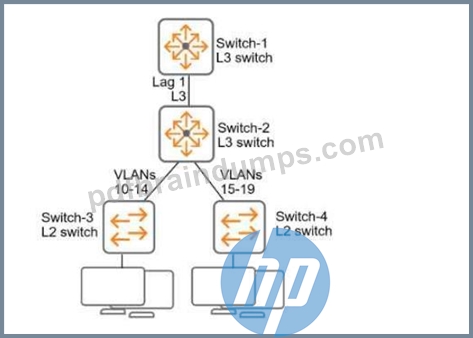
All of the switches in the exhibit are AOS-CX switches.
What is the preferred configuration on Switch-2 for preventing rogue OSPF routers in this network?
- A. Configure OSPF authentication on Lag 1 in MD5 mode.
- B. Configure OSPF authentication on VLANs 10-19 in password mode.
- C. Disable OSPF entirely on VLANs 10-19.
- D. Configure passive-interface as the OSPF default and disable OSPF passive on Lag 1.
Answer: A
Explanation:
Why MD5 Authentication on Lag 1 is Preferred:
* Lag 1 is the primary link between Switch-2 and Switch-1, both of which are Layer 3 switches running OSPF.
* By enabling MD5 authentication, OSPF routers exchange authenticated packets, preventing unauthorized or rogue OSPF routers from forming adjacencies or injecting routes.
* MD5 is a secure authentication method and ensures the integrity and authenticity of OSPF communications.
Other Options Analysis:
* A. Configure OSPF authentication on VLANs 10-19 in password mode: While configuring authentication on VLAN interfaces could secure VLAN-specific OSPF traffic, it is less effective because the main threat of rogue OSPF comes from unauthorized L3 devices connected via the backbone (Lag 1).
* C. Disable OSPF entirely on VLANs 10-19: Disabling OSPF on these VLANs is not a preferred solution because OSPF is needed to route traffic in this design.
* D. Configure passive-interface as the OSPF default and disable OSPF passive on Lag 1: While passive interfaces prevent OSPF from forming adjacencies, it does not directly prevent rogue routers.
Passive mode only limits OSPF advertisements on specific interfaces.
NEW QUESTION # 103
A company requires a centralized audit trail for commands that managers enter on AOS-CX switches.
What can you set up on the switches to meet this requirement?
- A. RADIUS start-stop and interim accounting with the port-access option
- B. SSH public key authentication for all managers who access the AOS-CX switches
- C. Command authorization to HPE Aruba Networking ClearPass Policy Manager (CPPM) acting as a TACACS+ server
- D. Logging to a Syslog server with the severity set at error level
Answer: C
Explanation:
For centralized tracking of administrator command activity, TACACS+ with ClearPass is the correct solution. TACACS+ is designed for network device administration because it separates authentication, authorization, and accounting. When ClearPass acts as a TACACS+ server, AOS- CX switches can send administrative login and command-related information to a centralized policy and audit platform. RADIUS start-stop accounting with the port-access option is for network access sessions, not command auditing. SSH public key authentication improves login security, but it does not create a centralized record of entered commands. Basic syslog at error severity records system events and errors, not a reliable command audit trail. TACACS+ command authorization with CPPM is the correct administrative control.
NEW QUESTION # 104
A company lacks visibility into the many different types of user and loT devices deployed in its internal network, making it hard for the security team to address those devices.
Which HPE Aruba Networking solution should you recommend to resolve this issue?
- A. HPE Aruba Networking ClearPass OnBoard
- B. HPE Aruba Networking ClearPass Device Insight (CPDI)
- C. HPE Aruba Networking Network Analytics Engine (NAE)
- D. HPE Aruba Networking Mobility Conductor
Answer: B
NEW QUESTION # 105
Your company wants to implement Tunneled EAP (TEAP).
How can you set up HPE Aruba Networking ClearPass Policy Manager (CPPM) to enforce certificated-based authentication for clients using TEAP?
- A. Select a service certificate when you specify TEAP as a service's authentication method.
- B. For the service using TEAP, set the authentication source to an internal database.
- C. Select an EAP-TLS-type authentication method for the TEAP method's inner method.
- D. Create an authentication method named "TEAP" with the type set to EAP-TLS.
Answer: C
Explanation:
To set up HPE Aruba Networking ClearPass Policy Manager (CPPM) to enforce certificate-based authentication for clients using Tunneled EAP (TEAP), you need to select an EAP-TLS-type authentication method for TEAP's inner method. TEAP allows for a combination of certificate-based (EAP-TLS) and password-based (EAP-MSCHAPv2) authentication. By choosing EAP-TLS as the inner method, you ensure that the clients are authenticated using their certificates, thus enforcing certificate-based authentication within the TEAP framework.
NEW QUESTION # 106
You have configured an AOS-CX switch to implement 802.1X on edge ports. Assume ports operate in the default auth-mode. VolP phones are assigned to the
"voice" role and need to send traffic that is tagged for VLAN 12.
Where should you configure VLAN 12?
- A. As the trunk native VLAN on edge ports and the trunk native VLAN on the "voice" role
- B. As the allowed trunk VLAN in the "voice" role (and not in the edge port settings)
- C. As the trunk native VLAN in the "voice" role (and not in the edge port settings)
- D. As a trunk allowed VLAN on edge ports and the trunk native VLAN in the "voice" role
Answer: B
Explanation:
When configuring 802.1X authentication on edge ports of an AOS-CX switch and assigning VoIP phones to a
"voice" role, the correct approach is to configure VLAN 12 as the allowed trunk VLAN in the "voice" role.
This setup ensures that traffic tagged for VLAN 12 is appropriately managed by the role applied to the VoIP phones. In AOS-CX switches, the role-based VLAN configuration allows for more granular control and ensures that the VoIP phones' traffic is handled correctly without altering the edge port settings, which typically operate with default settings for authentication.
Reference: Detailed configuration and role assignment practices for AOS-CX switches can be found in Aruba's configuration guides and documentation related to AOS-CX switch deployments.
NEW QUESTION # 107
Refer to the exhibits.
HPE Aruba Networking ClearPass Policy Manager (CPPM) is authenticating 802.1X clients using Active Directory as the source. CPPM has a custom attribute for AD that uses AccountStatus as userAccountControl .
Which enforcement profile does CPPM apply to a client that:
* Succeeds in authenticating to an active AD user account: userAccountControl = 512
* Does not succeed at authenticating as a computer
- A. Deny Access Profile
- B. profile1
- C. profile2
- D. profile3
Answer: D
Explanation:
The role mapping policy uses Evaluate all , so CPPM checks all role-mapping rules. The client has userAccountControl = 512 , which matches the first AccountStatus rule and assigns role1 . The client does not authenticate as a computer, so it does not receive the built-in [Machine Authenticated] role. The enforcement policy uses First applicable , so CPPM checks the rules from top to bottom and applies the first matching rule only. Rule 1 requires role1 and [Machine Authenticated] , so it does not match. Rule 2 requires role2 and [Machine Authenticated] , so it does not match. Rule 3 requires only [Machine Authenticated] , so it also does not match. Rule 4 requires role1 , which matches. Therefore, CPPM applies profile3 .
NEW QUESTION # 108
Refer to the exhibit.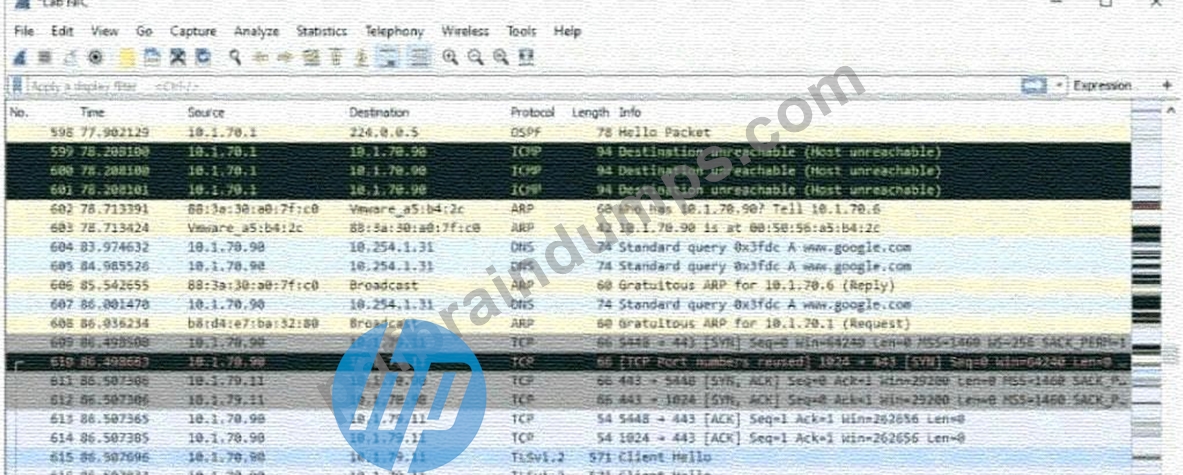
The exhibit shows a saved packet capture, which you have opened in Wireshark. You want to focus on the complete conversation between 10.1.70.90 and 10.1.79.11 that uses source port 5448.
What is a simple way to do this in Wireshark?
- A. Click the Source column and then the Destination column to sort the packets into the desired order.
- B. Right-click one of the packets between those addresses and choose to follow the stream.
- C. Apply a capture filter that selects for TCP port 5448.
- D. Apply a capture filter that selects for both the 10.1.70.90 and 10.1.79.11 IP addresses.
Answer: B
Explanation:
* Wireshark: Follow TCP Stream:
* Wireshark provides an intuitive feature to filter and display a complete TCP conversation.
* By right-clicking any packet within the conversation and selecting "Follow # TCP Stream", Wireshark isolates and displays the entire conversation.
* This feature allows you to view the communication in a simplified, sequential manner, including requests and responses.
* Option Analysis:
* Option A: Incorrect. Capture filters only apply during packet capturing, not for analyzing already saved packet captures.
* Option B: Incorrect. Sorting packets helps with organizing data but does not isolate a complete conversation.
* Option C: Incorrect. A capture filter for TCP port 5448 would have to be applied before capturing; it does not work for saved data.
* Option D: Correct. Right-clicking a packet and choosing "Follow TCP Stream" is the simplest way to display the full conversation between 10.1.70.90 and 10.1.79.11 on port 5448.
Steps in Wireshark to Follow a TCP Stream:
* Locate any packet within the desired conversation (e.g., between 10.1.70.90 and 10.1.79.11 on TCP port 5448).
* Right-click on the packet.
* Choose "Follow" # "TCP Stream".
* Wireshark will display the entire TCP conversation, including both directions of communication.
This feature is especially useful when troubleshooting or analyzing detailed interactions between hosts.
NEW QUESTION # 109
A ClearPass Policy Manager (CPPM) service includes these settings:
Role Mapping Policy:
Evaluate: Select first
Rule 1 conditions:
Authorization:AD:Groups EQUALS Managers
Authentication:TEAP-Method-1-Status EQUALS Success
Rule 1 role: manager
Rule 2 conditions:
Authentication:TEAP-Method-1-Status EQUALS Success
Rule 2 role: domain-comp
Default role: [Other]
Enforcement Policy:
Evaluate: Select first
Rule 1 conditions:
Tips Role EQUALS manager AND Tips Role EQUALS domain-comp Rule 1 profile list: domain- manager Rule 2 conditions:
Tips Role EQUALS manager
Rule 2 profile list: manager-only
Rule 3 conditions:
Tips Role EQUALS domain-comp
Rule 3 profile list: domain-only
Default profile: [Deny access]
A client is authenticated by the service. CPPM collects attributes indicating that the user is in the Contractors group, and the client passed both TEAP methods.
Which enforcement policy will be applied?
- A. manager-only
- B. domain-manager
- C. domain-only
- D. [Deny Access Profile]
Answer: D
NEW QUESTION # 110
You are configuring the Gateway IDS/IPS settings for an HPE Aruba Networking Central group.
What is a reason to set the Inspection Mode to IPS instead of IDS?
- A. The company wants to enforce stricter policies associated with lower CVSS scores.
- B. The company has a dedicated security staff that can respond to alerts quickly.
- C. The company's highest priority is mitigating potential threats immediately.
- D. The company is concerned about false positives disrupting connectivity.
Answer: C
Explanation:
IDS mode is detection-oriented. It identifies suspicious traffic and raises alerts, but it does not actively block the traffic. IPS mode is prevention-oriented. It can actively drop or block traffic that matches enabled threat signatures or prevention rules. Therefore, IPS is appropriate when the organization's top priority is immediate threat mitigation rather than only visibility. A dedicated security team that can respond quickly may make IDS acceptable because analysts can investigate alerts manually. Concern about false positives disrupting connectivity is a reason to be cautious with IPS, not a reason to enable it. CVSS thresholds can affect which signatures are enabled, but the main reason to choose IPS is active blocking and faster mitigation.
NEW QUESTION # 111
You are establishing a cluster of HPE Aruba Networking ClearPass servers. (Assume that they are running version 6.9.).
For which type of certificate it is recommended to install a CA-signed certificate on the Subscriber before it joins the cluster?
- A. Database
- B. RadSec
- C. HTTPS
- D. RADIUS/EAP
Answer: C
Explanation:
When establishing a cluster of HPE Aruba Networking ClearPass servers, it is recommended to install a CA-signed certificate for HTTPS on the Subscriber before it joins the cluster. This ensures secure communication between the servers in the cluster and provides a trusted certificate for client connections.
1.HTTPS Security: A CA-signed certificate for HTTPS ensures that all web-based communication to and from the ClearPass server is encrypted and secure.
2.Cluster Communication: Secure communication between ClearPass nodes in the cluster is essential for synchronization and data integrity.
3.Client Trust: Clients accessing the ClearPass server will trust the CA-signed certificate, avoiding security warnings and ensuring smooth operations.
NEW QUESTION # 112
The security team needs you to show them information about MAC spoofing attempts detected by HPE Aruba Networking ClearPass Policy Manager (CPPM).
What should you do?
- A. Export the Access Tracker records on CPPM as an XML file.
- B. Use ClearPass Insight to run an Active Endpoint Security report.
- C. Integrate CPPM with ClearPass Device Insight (CPDI) and run a security report on CPDI.
- D. Show the security team the CPPM Endpoint Profiler dashboard.
Answer: B
Explanation:
To show the security team information about MAC spoofing attempts detected by HPE Aruba Networking ClearPass Policy Manager (CPPM), you should use ClearPass Insight to run an Active Endpoint Security report. ClearPass Insight provides comprehensive reporting capabilities that include detailed information on security incidents, such as MAC spoofing attempts. By generating this report, you can provide the security team with a clear overview of the detected spoofing activities, including the endpoints involved and the context of the events.
NEW QUESTION # 113
What is one benefit of integrating HPE Aruba Networking ClearPass Policy Manager (CPPM) with third-party solutions such as Mobility Device Management (MDM) and firewalls?
- A. CPPM can take over filtering internal traffic so that the third-party solutions have more processing power to devote to filtering external traffic.
- B. CPPM can exchange contextual information about clients with third-party solutions, which helps make better decisions.
- C. CPPM can make the third-party solutions more secure by adding signature-based threat detection capabilities.
- D. CPPM can offload policy decisions to the third-party solutions, enabling CPPM to respond to authentication requests more quickly.
Answer: B
NEW QUESTION # 114
A company wants HPE Aruba Networking ClearPass Policy Manager (CPPM) to periodically poll Microsoft Endpoint Manager (formerly Intune) for attributes about its managed clients.
What should you do on ClearPass to permit this integration?
- A. Create an Intune authentication source on CPPM
- B. Configure Endpoint Manager (Intune) as an event source on CPPM
- C. Install the Intune extension from ClearPass Guest
- D. Import the Intune dictionary into the ClearPass dictionaries
Answer: A
Explanation:
For ClearPass to periodically query Microsoft Intune / Endpoint Manager for device attributes (compliance, owner, OS, etc.), you must configure Intune as an authentication source in Policy Manager. The ClearPass- Intune integration is implemented through an API-based auth source which CPPM polls on a schedule; it is not done via Guest extensions or syslog/event sources.
Aruba's Intune integration guides describe configuring a "Microsoft Intune" (or "Endpoint Manager") authentication source in ClearPass and supplying the Azure app registration details so CPPM can poll Intune via Microsoft Graph.
* Option A is incorrect: the Intune integration is not a ClearPass Guest extension.
* Option B is insufficient: adding dictionaries only defines attributes; it does not enable scheduled polling.
* Option D is incorrect: Intune is not used as a syslog/event source for this use case; ClearPass initiates the polling via the authentication source.
Therefore, the correct configuration step is: Create an Intune authentication source on CPPM (Option C).
NEW QUESTION # 115
A company uses HPE Aruba Networking ClearPass Device Insight (CPDI) (the standalone application option). In the details for a generic device cluster, you see a recommendation for
"Windows 8/10" with 70% accuracy.
What does this mean?
- A. CPDI has matched these devices against several, conflicting system rules. 70% of those rules are for "Windows 8/10" devices.
- B. CPDI has used MAC OUI to group these devices together. The average device's MAC address matches 70% of the "Windows 8/10" OUI.
- C. CPDI has detected that these devices match about 70% of the system rule for defining "Windows
8/10" devices. - D. CPDI has grouped this cluster with similar classified devices. 70% of those classified devices are
"Windows 8/10."
Answer: C
Explanation:
When HPE Aruba Networking ClearPass Device Insight (CPDI) shows a recommendation for
"Windows 8/10" with 70% accuracy for a generic device cluster, it means that CPDI has detected that these devices match about 70% of the system rule criteria for defining "Windows 8/10" devices. This percentage indicates the confidence level based on the observed characteristics and behavior of the devices, helping administrators understand the likelihood that these devices are indeed running Windows 8 or 10.
NEW QUESTION # 116
What role can Internet Key Exchange (IKE)/IKEv2 play in an HPE Aruba Networking client-to-site VPN?
- A. It helps to negotiate the IPsec SA automatically and securely.
- B. It provides an alternative to IPsec that is suitable for legacy clients.
- C. It provides a more modern and secure alternative to IPsec.
- D. It helps remote clients download IPsec profiles for later use.
Answer: A
Explanation:
Internet Key Exchange (IKE)/IKEv2 plays a crucial role in an HPE Aruba Networking client-to-site VPN by helping to negotiate the IPsec Security Association (SA) automatically and securely.
IKE/IKEv2 handles the authentication and key exchange processes, ensuring that both the client and the VPN gateway can establish a secure IPsec tunnel.
1. SA Negotiation: IKE/IKEv2 automates the negotiation of the Security Association, which defines the parameters for the secure IPsec tunnel.
2. Secure Authentication: It provides a secure method for authenticating the communicating parties and exchanging cryptographic keys.
3. Efficiency: Using IKE/IKEv2 simplifies the setup and maintenance of secure VPN connections, enhancing the overall security and reliability of the VPN.
NEW QUESTION # 117
You are configuring the HPE Aruba Networking ClearPass Device Insight Integration settings on ClearPass Policy Manager (CPPM). For which use case should you set the 'Tag Updates Action" to " apply for all tag updates"?
- A. When you plan to have CPPM issue CoAs for clients with new tags, but do not want to have to list those specific tags in the Device Integration settings in advance.
- B. When CPPM is gathering posture information for CPDI, and you want CPDI to always have access to the most up-to-date information.
- C. When the Device Insight integration poll interval is set to a relatively long interval but you still want CPPM to be informed quickly about devices' new tags.
- D. When Device Insight tags are only used to identify dangerous devices, and you want to disconnect those devices without having to set up new rules in enforcement policies.
Answer: A
Explanation:
* Tag Updates Action - "Apply for All Tag Updates":
* This setting ensures that all updated tags from Device Insight (CPDI) are applied dynamically.
* It is particularly useful when you want to trigger Change of Authorization (CoA) without explicitly predefining the tag values.
* Option D: Correct. This setting allows CPPM to issue CoAs automatically for updated tags without requiring prior configuration of specific tags.
* Option A: Incorrect. The setting is not directly related to reducing the poll interval latency.
* Option B: Incorrect. Disconnecting devices based on dangerous tags would require predefined enforcement rules.
* Option C: Incorrect. Posture information updates do not directly rely on this setting.
NEW QUESTION # 118
A company wants to use HPE Aruba Networking ClearPass Policy Manager (CPPM) to profile Linux devices.
You have decided to schedule a subnet scan of the devices' subnets. Which additional step should you complete before scheduling the scan?
- A. Configure SNMP in the network device settings for the switches that support the Linux devices.
- B. Set up SSH accounts on CPPM and map them to the Linux devices' subnets.
- C. Enable the Data Port in the ClearPass server settings and connect that port to the network.
- D. Enable WMI probing in the cluster-wide parameters.
Answer: C
Explanation:
* Subnet Scan Requirements for Profiling:
* For ClearPass to scan and profile devices in a subnet, the Data Port must be enabled on the ClearPass server and connected to the network.
* This ensures that ClearPass can send and receive the required packets for device discovery and profiling.
* Option Analysis:
* Option A: Incorrect. SSH accounts are not required for subnet scanning.
* Option B: Incorrect. WMI probing is for Windows systems, not Linux devices.
* Option C: Correct. The Data Port is essential for subnet scans and must be properly configured and connected.
* Option D: Incorrect. SNMP is used for network device monitoring, not Linux device profiling.
NEW QUESTION # 119
......
Get to the Top with HPE7-A02 Practice Exam Questions: https://lead2pass.pdfbraindumps.com/HPE7-A02_valid-braindumps.html